Making Tax Digital
VAT and Income Tax, kept and sent the way HMRC now asks
Making Tax Digital means keeping records in software and sending them to HMRC from it. VAT has worked this way for every VAT registered business since April 2022. Income Tax started for sole traders and landlords on 6 April 2026.
Do I need MTD?
Which of your clients it applies to
A quick guide, client by client. Check each client's own position with HMRC, because exemptions and special cases apply.
A VAT registered business
MTD for VAT applies now
Every VAT registered business keeps digital records and files its VAT returns through software, whatever its turnover, unless HMRC has granted it an exemption.
A sole trader or landlord
MTD for Income Tax applies by income
From 6 April 2026 if qualifying income was over £50,000, from 2027 over £30,000 and from 2028 over £20,000. Qualifying income is turnover from self employment and property added together, before expenses.
A limited company
MTD for VAT if registered
MTD for Income Tax does not apply to the company. Its directors may still need it for their own property or self employment income.
A partnership
MTD for VAT if registered
HMRC has not yet set a date for partnerships to join MTD for Income Tax.
HMRC's own checks: Making Tax Digital for VAT and who needs Making Tax Digital for Income Tax.
MTD for VAT
Every box of the return traced back to its source
The return is prepared from the ledger you reconciled. Open any box and you see the transactions behind it, and behind each transaction the document it came from.
- Standard, cash, flat rate and annual accounting
- HMRC's obligations, payments and penalties for each client
- Health checks for VAT anomalies before the return is locked
- A fresh second factor before a return is submitted
- A filed return and its period locked against change
Live once HMRC approves itBuilt and tested against HMRC's test service. Returns are prepared in full today.
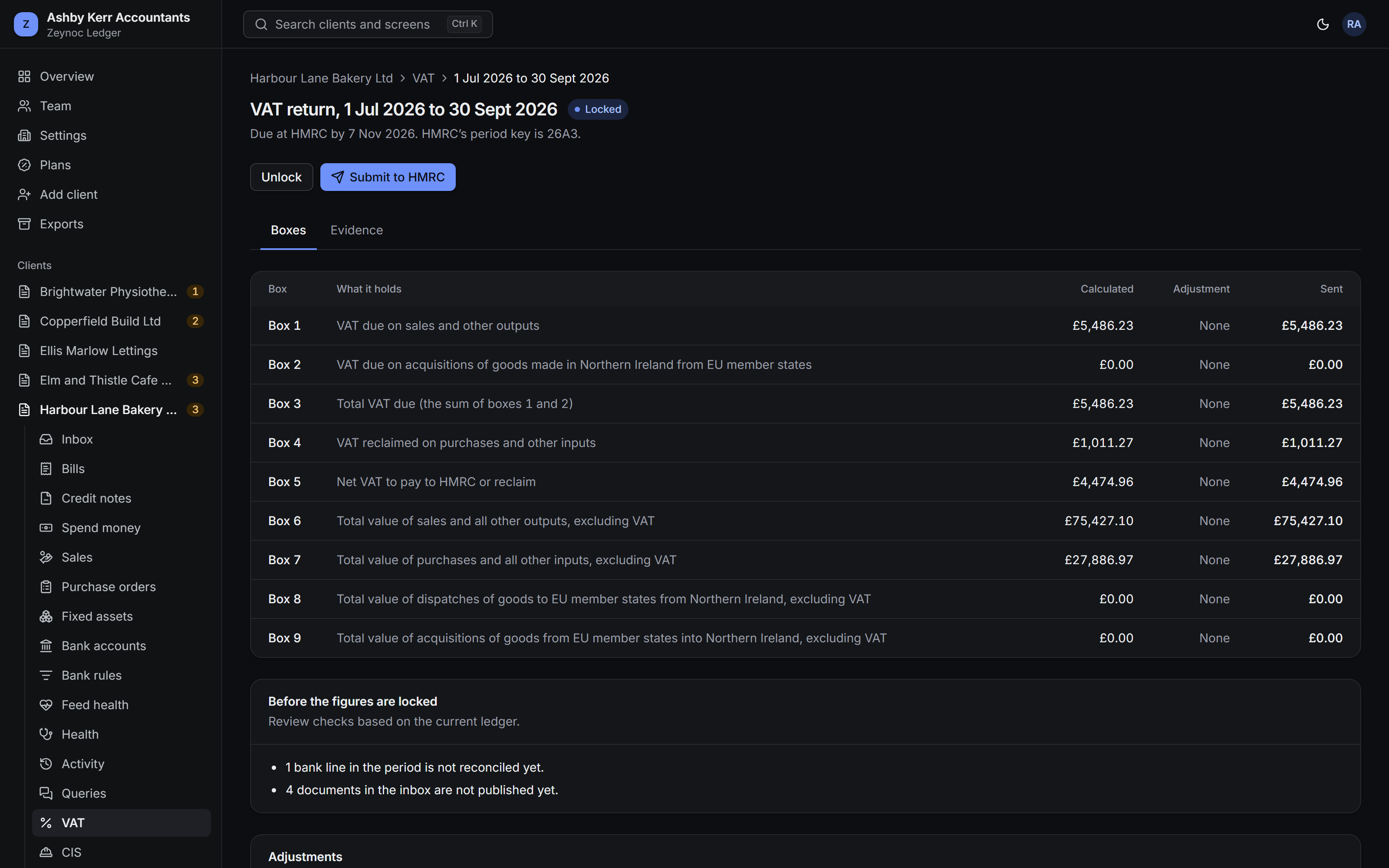
- VAT return ready to submit
MTD for Income Tax
The whole Income Tax year, not just the quarterly updates
Sole traders and landlords send four quarterly updates and a final declaration. Zeynoc Ledger covers the year from the first update to the declaration, with every kind of income in one return.
| From | Qualifying income |
|---|---|
| 6 April 2026 | over £50,000 on the 2024 to 2025 tax return |
| 6 April 2027 | over £30,000 on the 2025 to 2026 tax return |
| 6 April 2028 | over £20,000 on the 2026 to 2027 tax return |
- 1
Four quarterly updates
Income and expenses for each business, drawn from the books and sent each quarter.
- 2
The year end
Adjustments, allowances and the figures that only settle once the year is over.
- 3
Everything else
Other income, employment, savings, dividends, pensions, reliefs and losses, in one editor.
- 4
The final declaration
One calculation, confirmed with the client, with a record of who confirmed it and when.
Built to HMRC's published specifications and tested against HMRC's test service. HMRC has paused approvals of new software for the 2026 to 2027 tax year, and we will apply for live filing when it opens them again. It is on every plan.
Get your MTD clients ready
Tell us which clients you would start with. A person on the team reads every request and replies by email.